T4K3.news
Earendel Likely a Star Cluster
New analysis challenges Earendel being a single star and points to a distant star cluster seen via gravitational lensing.

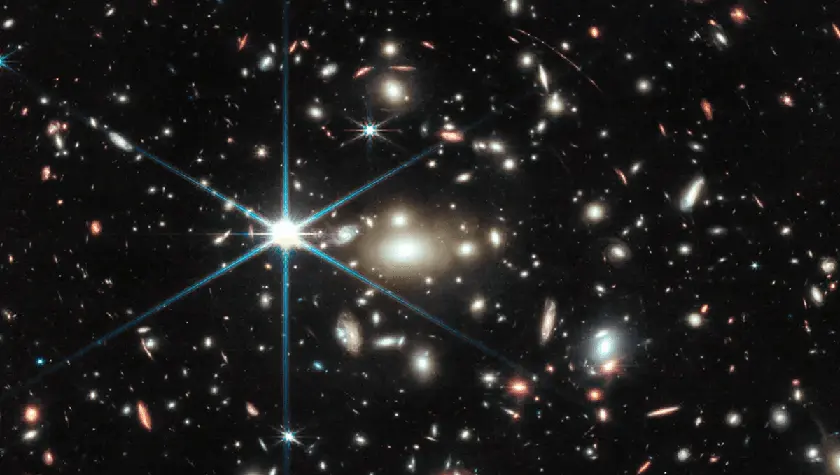


New analysis questions whether Earendel is a single star and suggests it could be a compact star cluster seen through gravitational lensing.
Earendel Likely a Star Cluster Instead of Lone Star
Earendel was spotted in 2022 by the Hubble Space Telescope thanks to a gravitational lens created by the foreground galaxy cluster WHL0137-08. The light traveled about 28 billion years to reach us, with the emission dating to roughly 13 billion years ago. Early readings suggested a solitary star about 50 times the Sun’s mass, possibly part of a binary system. The discovery relied on the Sunrise Arc, a stretched image of a distant galaxy produced by lensing, and follow‑up data from the James Webb Space Telescope added more detail. A new study uses stellar population modeling to reassess what Earendel might be.
The latest paper compares Earendel to nearby features in the same arc and tests whether the observed spectrum fits a simple stellar population model. The authors report that Earendel’s spectrum and the arc’s features are consistent with metal‑poor populations and that the fits stay strong across several stellar population libraries. They conclude Earendel is best described as a star cluster rather than a single star, though a binary origin isn’t completely ruled out. The interpretation sits with expectations for what the first star‑forming regions may have looked like and aligns Earendel with early globular cluster formation rather than a lone behemoth.
Key Takeaways
"It's the most distant star that has been discovered thus far, which is very exciting just for the superlative of it."
Comment on the significance of the record distance.
"What's reassuring about this work is that if Earendel really is a star cluster, it isn't unexpected!"
Lead author reacting to the star cluster interpretation.
"Earendel seems fairly consistent with how globular clusters in the local universe would have looked in the first billion years."
Author describing how Earendel fits with known cluster archetypes.
This update shows how science evolves with better data. Gravitational lensing opens a window into the past, but it also complicates what we are really seeing. If Earendel is a star cluster, the finding still teaches us about star formation in the universe’s first billion years and the kinds of structures that could survive to later eras. The result also underscores the cautious pace of astronomy, where new models must be tested against multiple observations before a firm label is assigned. In short, the cosmos keeps reshaping its own story as data improves.
Highlights
- A single dot on a lensing arc may hide an entire era
- What we see in Earendel now shapes what we expect from the early universe
- Earendel keeps challenging how we read distant objects
As telescopes sharpen, Earendel will continue to challenge and refine our picture of the early cosmos.
Enjoyed this? Let your friends know!
Related News

Earendel may be a star cluster not a lone star
Webb spots distant jellyfish galaxy
Best celestial sights for stargazing announced
Cosmic Horseshoe Reveals Heaviest Black Hole Yet
Bridge of stars links two galaxies in Abell 3667
The Seven Sisters eclipse occurs on July 20
Moon Near Pleiades in Early Morning Sky August 16 17
Astronomers construct detailed image of Abell 3667