T4K3.news
Moon Near Pleiades in Early Morning Sky August 16 17
The Moon will pass near the Pleiades in the pre-dawn hours of August 16 and 17, with Uranus nearby. Binoculars or a small telescope help observers spot both the star cluster and Uranus.

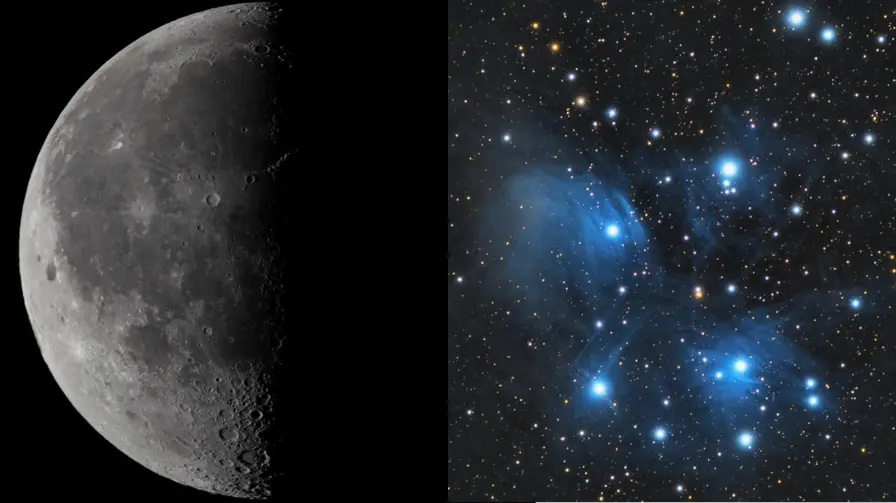


A pre-dawn Moon passes close to the Pleiades with Uranus nearby, inviting beginners to look up on August 16 and 17.
Moon Near Pleiades in Early Morning Sky August 16 17
The Moon will sweep close to the Pleiades in the early morning hours of August 16 and 17. Look to the eastern horizon about an hour after midnight on August 16 to see the half lit lunar disk as it reaches its third quarter at 1:12 a.m. EDT, roughly 5 degrees to the upper right of the cluster. On August 17 the Moon sits about 5 degrees to the lower left of the Pleiades as it moves toward dawn.
The Pleiades, also called the Seven Sisters, may appear as a faint smudge to the naked eye, especially with some moonlight. Averted vision can help bring the cluster into view. A smartphone astronomy app can guide you to the cluster and nearby deep space objects.
Using a pair of 10x50 binoculars will reveal the Pleiades seven brightest stars, along with visible lunar features such as crater rims Kepler and Copernicus near the Moon’s limb. An 8-inch telescope provides a clearer view of the cluster against faint interstellar dust and can help place Uranus as a tiny aqua dot less than 5 degrees away on August 16. The Moon will drift away after dawn on August 17 as it approaches new moon, so plan a quiet dawn session if conditions allow.
Key Takeaways
"The Moon and Pleiades remind us that the sky is a shared classroom."
Educational value of the event
"Uranus will appear as a tiny aqua dot with the right gear."
Observational detail from the event
"A clear night can turn an ordinary dawn into a memory."
Emotional reflection on observing dawn
"Smartphone apps guide beginners to a sky they might otherwise miss."
Technology aiding accessibility
This event shows how skywatching remains an inclusive, low-cost entry into science. Simple observing tips and readily available gear make it possible for families, students, and hobbyists to join a shared moment with the night sky. The mention of smartphone apps highlights how technology can broaden access rather than replace traditional binoculars and small telescopes.
Viewing at dawn will be easier in dark locations, but moonlight still adds a challenge. The piece underscores the appeal of bright clusters like the Pleiades as gateways to more distant objects, and it points to potential community outreach that makes early morning sessions feasible for clubs and schools.
Highlights
- A quiet celestial moment that makes stargazing feel personal
- Smartphone apps turn a dawn oddity into a guided tour of the sky
- The night sky invites patience and curiosity
- Look up and a tiny aqua dot becomes Uranus
The night sky keeps inviting us to look up.
Enjoyed this? Let your friends know!
Related News
Perseid Shower Peaks Tonight

Planet Parade Lights Up Skies
Perseid peak nears as moonlit skies challenge visibility
Perseids Peak With Live Viewing
Double meteor shower peaks tonight in the UK
Perseid meteor shower peaks with bright planets visible
Perseid Meteor Shower Starts Soon
Perseid meteor shower set for 2025 viewing